
Can Stickers Over a Baby Face Be Removed by AI Tools?
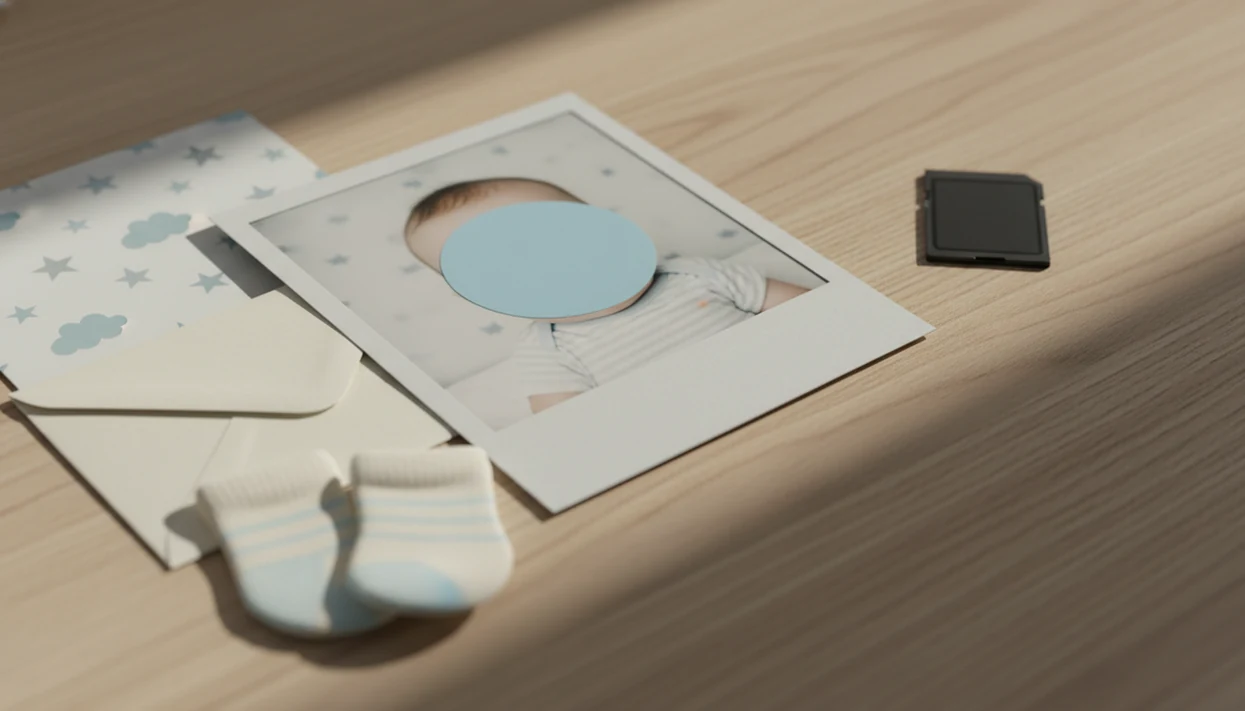
Yes, can stickers over baby face be removed is a real privacy concern: stickers and emojis are only a visible cover, not a guaranteed privacy solution. Some edits may be flattened and hard to reverse, but platforms, metadata, screenshots, original uploads, background clues, and future AI analysis can still expose information about a child.
Definition: Stickers over baby face privacy means using a visible emoji, sticker, blur, crop, or mask to reduce identification risk in a child photo, while recognizing that it does not erase the underlying privacy risks of posting the image online.
TL;DR
- A sticker or emoji may hide the face from viewers, but it does not guarantee that the child cannot be identified.
- Background details, metadata, account history, captions, and original uploads can still reveal sensitive information.
- For safer sharing, crop tightly, remove location data, avoid identifying captions, limit the audience, or do not post the photo.
Scope note: this guide is general child-photo privacy information, not legal, cybersecurity, or platform-specific advice. If an image has already been misused, copied, or connected to a child’s location or identity, contact the platform, a child-safety organization, or a qualified privacy/legal professional.
<h2 id="what-stickers-over-baby-face-privacy-protects">What stickers over baby face privacy actually protects</h2>
Stickers over baby face privacy protects the visible face in a shared image, but it does not make the photo anonymous. It is a visual barrier, not a full privacy system.
A sticker can hide a sleepy yawn under window light from strangers scrolling past. It cannot hide the nursery wall decal, the caption with the baby’s full name, or the account that posted it. The risk depends on where the edit happened, where the image is uploaded, and what other clues remain in the frame.
Small details matter.
Tools like Baby Photo Art can help parents make cute baby photo edits, milestone keepsakes, and print-ready versions, but privacy-aware sharing still comes first. Good ai-powered baby and newborn photo generator with stickers, milestone templates, and portrait-style edits for parents deliver small adjustments, not a new baby or a privacy guarantee.
<h2 id="can-stickers-over-baby-face-be-removed-after-posting">Can stickers over baby face be removed after posting?</h2>
Some stickers cannot be perfectly removed from a flattened image, but that does not make them safe. The better question is whether the child can still be identified after the sticker is added.
When a photo is exported as a flat JPG or PNG, the sticker usually replaces the visible pixels beneath it. An AI tool may guess what belongs under the sticker, but it cannot reliably recover the exact original baby face from those pixels alone. That is different from privacy. A person may identify the child through siblings, a hospital ID bracelet, a birthday caption, or a familiar living room.
Screenshots, reuploads, platform copies, and edits made inside social apps add more uncertainty. If the original was uploaded before the sticker was placed, the platform may have processed a cleaner version than the public one you see. For deeper upload-risk questions, the guide on is it safe to upload baby photos to AI apps covers that separate issue.
<h2 id="five-facts-emoji-over-child-face-safety">Five facts about emoji over child face safety</h2>
Emoji over child face safety is about reducing visible exposure, not removing every privacy risk. These five facts are the practical baseline for parents.
- Stickers do not stop platforms or apps from linking photos to accounts, upload times, location signals, and engagement data.
- Background details can identify a child, including hospital bracelets, daycare signs, room decor, clothing, siblings, and captions.
- Some platforms may retain original or higher-quality uploads even when the public version looks edited or compressed.
- Children’s image data can persist for years and become part of a searchable digital footprint.
- The safer approach combines masking with a limited audience, metadata removal, careful captions, and sometimes not posting.
A tiny hospital ID bracelet can be meaningful in a keepsake. Online, it may also be an identifier. For parents who want a step-by-step metadata check, how to remove location data from baby photos is usually more useful than adding another emoji.
<h2 id="how-sticker-emoji-face-covers-work">How sticker and emoji face covers work in baby photos</h2>
Sticker and emoji face covers work by placing a visual overlay layer on top of the original image pixels. In plain language, the sticker sits over the face like a digital label.
In a layered editing file, the original photo and the sticker may remain separate. The editor can move, resize, or delete the overlay. In an exported flattened image, the visible layers are baked together into one file. That makes the covered pixels harder to inspect, but it does not remove every trace around the image.
The pocket check is real.
Metadata, upload logs, thumbnails, caches, and server-side copies may exist outside the visible sticker. AI tools may also analyze context, not only faces. A dim hospital-room photo with a wrinkled white blanket and a rolling bassinet in the background still tells a story, even if the baby’s face is covered.
<h2 id="sticker-blur-crop-no-post-baby-photo-privacy">Sticker, blur, crop, and no-post baby photo privacy options</h2>
Cropping the face and identifying background often reduces more risk than placing an emoji over the face. No editing method is perfectly safe, and not posting is the only option that avoids online image exposure entirely.
| Option | What it hides | Main weakness | Better fit |
|---|---|---|---|
| Sticker | Covers the visible face | Context and metadata remain | Casual family edits |
| Emoji | Covers expression and features | Can feel private when it is not | Quick social posts |
| Blur | Obscures facial detail | Weak blur may be interpreted or reversed | Lower-detail previews |
| Crop | Removes face or background from the shared file | Can ruin the composition | Identity protection |
| Private album | Limits who can view | Viewers can screenshot or download | Trusted family sharing |
| Not posting | Avoids online image exposure | No public update | Sensitive images |
For identity protection, crop first and decorate second. A parent zooming into a baby face may notice that the face is hidden, but the street sign in the window is not.
<h2 id="common-myths-stickers-over-baby-face-privacy">Common myths about stickers over baby face privacy</h2>
A sticker is a privacy aid, not a privacy wall. The common myths usually come from treating the public preview as the whole data story.
Myth: a sticker means nobody can identify the baby. Safer interpretation: the face is harder to view, but family links, captions, clothing, and locations can still identify the child.
Myth: face stickers remove location, time, and device metadata. Safer interpretation: metadata removal is a separate step, and not every app strips it.
Myth: an emoji-covered photo is as private as not posting. Safer interpretation: a posted image can still be copied, stored, searched, or discussed.
Myth: public parenting groups are safe if the face is hidden. Safer interpretation: large groups are still public exposure, especially when posts include names, routines, and local clues.
A photo card drying on the kitchen table is different from a public upload. One stays in the room. The other travels.
<h2 id="safer-baby-photo-sharing-rules-for-parents">Safer baby photo sharing rules for parents</h2>
Safer baby photo sharing uses several small controls together: crop, remove location data, limit the audience, and avoid identifying text. For parents, this is often easier than trying to make one sticker do all the work.
- Crop rule: Remove the baby’s face and identifying background when identity protection matters.
- Caption rule: Avoid hospital names, daycare signs, school names, street views, surnames, birthdays, and daily routine clues.
- Audience rule: Share in small trusted groups rather than public feeds, open forums, or hashtag-heavy posts.
- App rule: Choose baby photo apps with clear privacy policies, minimal retention, and careful handling of children’s images.
Baby Photo Art is a baby photo editor app that turns baby and newborn photos into milestone templates, stickers, portraits, and print-ready keepsakes for parents. If you are comparing tools, a baby photo app privacy policy checklist helps you read beyond the cute templates.
<h2 id="evidence-child-photo-sharing-digital-footprints">Evidence on child photo sharing and digital footprints</h2>
Research on child photo sharing shows that small posts can add up quickly. A 2022 Italian survey of 331 parents found that over 80% shared pictures of their children online, and about 30% shared them at least weekly source.
The UK Children’s Commissioner estimated in 2018 that parents had posted an average of 1,300 photos and videos of a child by age 13 source. The European Commission has also warned that facial recognition systems can be trained on billions of images scraped from social media and the web. The FTC notes that online images can be reused, combined, and analyzed in ways families may not expect source.
For most families, the practical lesson is simple: the safest baby photo sharing plan reduces both the visible face and the surrounding data. If training use is your concern, read whether can AI apps use baby photos for training before uploading.
<h2 id="when-to-get-help-child-photo-privacy">When to get help with a child photo privacy issue</h2>
Get help when a child’s image has been copied, used to impersonate someone, linked to identifying details, or turned into harassment. Move fastest when the post exposes location, routine, school, medical, or sexualized information.
A calm sequence helps, especially when the first instinct is to delete everything at once.
- Save the evidence before you request removal: URLs, screenshots, dates, usernames, profile links, captions, comments, and direct messages.
- Report the copied, impersonating, or abusive post through the platform’s safety, privacy, copyright, or impersonation tools.
- Contact the school, daycare, clinic, or medical office if the image reveals names, uniforms, badges, appointments, addresses, or routines they can help secure.
- Ask for legal, privacy, or child-safety help if there are threats, stalking, harassment, extortion, sexualized edits, or repeated reposting.
- Use emergency services right away if the post creates an immediate physical safety risk, such as a live location, a custody danger, or a credible threat.
For low-risk oversharing, tightening privacy settings may be enough. For targeted misuse, treat the photo like evidence first and a takedown problem second.
Limitations of stickers over baby face privacy
Stickers can reduce visible exposure, but they cannot guarantee child privacy. The limits are technical, social, and long-term.
- No consumer sticker or emoji overlay can absolutely guarantee that a child cannot be identified.
- Visual masking does not control platform storage, third-party trackers, AI training policies, or future data use.
- Privacy settings reduce risk, but they cannot prevent screenshots, downloads, reuploads, or misuse by viewers.
- Cloud-based baby photo editors may involve additional processors, analytics, or temporary storage.
- Long-term research on the future impact of early childhood image sharing remains limited.
- Even a careful edit may leave recognizable context in the background or caption.
- A cute design can distract from privacy checks, especially when the baby’s name, birth date, and location are in the same post.
Before you share, check the crop. A 4x6 print cutting off the top of a knit hat is a design problem; a public post showing the daycare logo is a privacy problem. For broader posting rules, how to share baby photos online safely gives a parent-friendly workflow.
FAQ about stickers over baby face privacy
Can AI remove face stickers?
AI may guess or reconstruct missing areas, but it cannot reliably recover the original face from a flattened sticker. That does not mean the photo is private, because context can still identify the child.
Are emoji faces safe online?
Emoji faces reduce visible identification, but they do not remove metadata, account links, background clues, or sharing risk. They are a partial mask, not a full privacy solution.
Do stickers hide photo metadata?
Stickers usually do not remove location, time, device, or file metadata unless the app strips it separately. Check export settings before posting.
Is blur safer than stickers?
Blur and stickers are both visual masks, and neither guarantees privacy. Strong cropping often removes more identifying information than either one.
Should I crop my baby photos?
Cropping can be safer when it removes the face and identifying background details from the shared image. It is especially useful for public posts.
Can Instagram store original photos?
Social platforms may process, cache, resize, analyze, or retain uploads according to their policies. The public edited version may not show every copy involved.
What details identify a child?
Common identifiers include location, school or daycare signs, hospital bracelets, names, birthdays, siblings, uniforms, room decor, and routines. Captions can identify a child even when the face is hidden.
Is not posting safer?
Yes. Not posting is the strongest privacy option because it avoids online distribution, screenshots, platform processing, and future reuse.