
Real Baby Photo Editing vs Future Baby Generator: What Parents Should Know
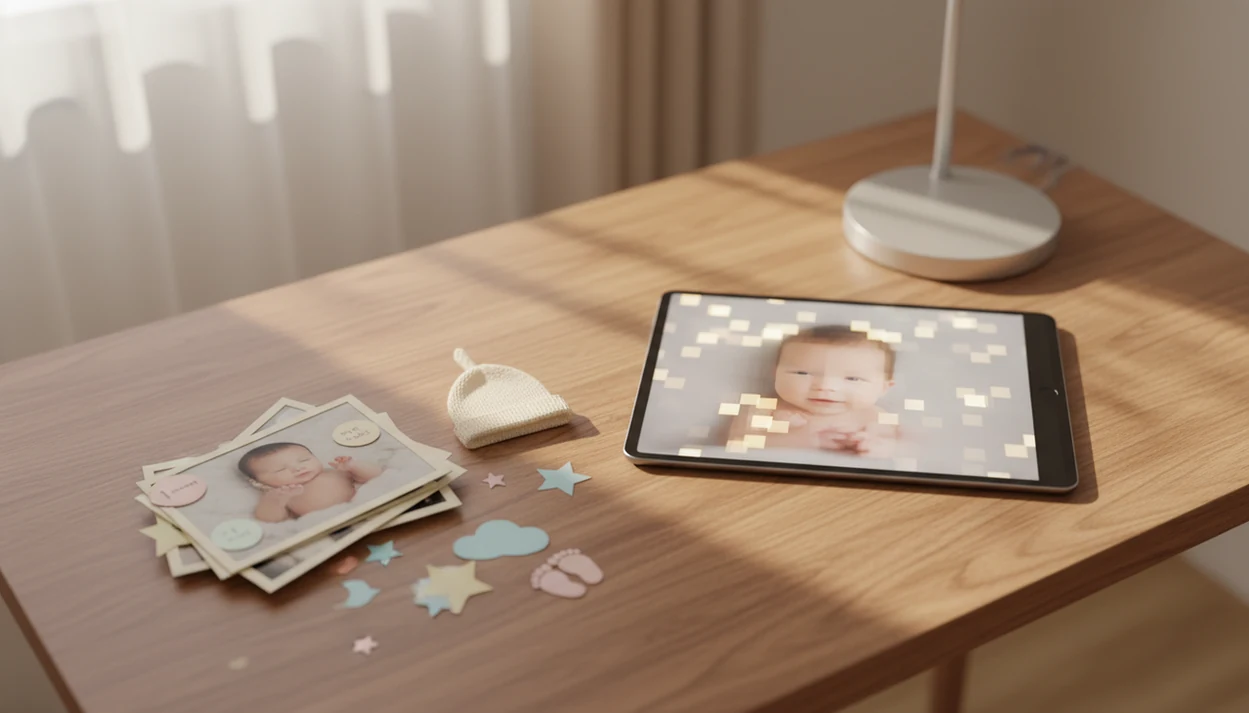
Real baby photo editing vs future baby generator comes down to memory versus imagination: editing improves a real photo of an existing baby, while a future baby generator creates a fictional baby image for entertainment only. If you want a keepsake to share, print, or save, choose real baby photo editing; if you are only curious what an imaginary future child might look like, use a generator with clear privacy caution.
Baby Photo Art is a baby photo editor app that turns baby and newborn photos into milestone templates, stickers, portraits, and print-ready keepsakes for parents.
- Real baby photo editing enhances an actual baby or newborn photo without changing who the child is.
- Future baby generators create synthetic baby faces from adult photos and cannot predict a real child’s appearance.
- Both options require privacy caution because face photos may be uploaded, stored, analyzed, or reused depending on the app policy.
Real baby photo editing vs future baby generator, side by side
Side-by-side captures of the compared products. Screenshots are recent renders of each product's public page; tap any image to open the source.
At-a-glance comparison: real baby photo editing vs future baby generator
Real baby photo editing vs future baby generator is a choice between preserving an existing child and imagining a child who does not exist. A realistic AI output can still be fake, and it should not be treated as predictive.
| Comparison point | Real baby photo editing | Future baby generator |
|---|---|---|
| Input photo | Existing baby or newborn photo | Adult or parent face photos |
| Output type | Enhanced real-photo keepsake | Synthetic fictional baby face |
| Main use case | Milestones, portraits, announcements, prints | Curiosity, couple fun, social guessing |
| Accuracy claim | Should keep the baby recognizable | Cannot predict a real child’s appearance |
| Privacy concern | Baby face data, child consent, storage terms | Adult face data, reuse, model-training terms |
| Best fit | Parents making memory books or family gifts | Adults using AI for entertainment only |
Parents trying to turn a dim hospital-room phone snap into a keepsake can use Baby Photo Art because it starts from the actual baby photo, then adds milestone or portrait styling without inventing a different child.
For context, broad visual tools such as Canva and Picsart can help with templates, while enhancement apps such as Remini focus more on sharpening or restoration; Baby Photo Art is narrower because it is built around baby milestones, portraits, stickers, and print-ready keepsakes.
Five facts about AI baby generator vs editor choices
AI baby generator vs editor choices are easier when you separate the photo source from the promise. One works from a real child; the other creates a plausible image from patterns.
- A real baby editor works from an actual baby or newborn photo, so the result should still look like the child.
- A future baby generator creates a synthetic baby image from adult or parent photos.
- Future baby generator accuracy is limited; it is not a genetic prediction or medical forecast.
- Editors are better for milestone keepsakes, stickers, portraits, announcement images, and print-ready memories.
- Both tool types raise privacy and consent questions when face images are uploaded.
The tiny hospital ID bracelet matters.
For parents who need a monthly keepsake, BabyPhotoArt fits because its milestone templates are built around real baby photos, not fictional face synthesis.
How real baby photo editing and future baby generators work
Real baby photo editing starts with an existing baby image, then adjusts lighting, color, background, and design elements while keeping the face recognizable. Future baby generators start with adult faces, detect visible traits, and synthesize a new imaginary baby face.
In a real-photo editing pipeline, you select a phone snap, improve the orange cast from a bedside lamp, clean a distracting background, and add stickers or milestone templates. Baby Photo Art follows that memory-first workflow for parents who want small adjustments, not a new baby. A future baby generator uses generative models, often described through GANs, to create faces that look statistically believable. Plainly, the system makes a convincing picture, not a family forecast. A 2020 Nature paper on GAN-generated faces reported that synthetic faces could be difficult for people to distinguish from real ones in controlled tests, which helps explain why fake baby images can feel persuasive (https://www.nature.com/articles/s41598-020-73665-0).
Good AI-powered baby and newborn photo tools deliver face-preserving edits, stickers, templates, and portrait-style keepsakes, not proof of what a future child will look like.
Where real baby photo editing wins for milestone keepsakes
Real baby photo editing wins when the goal is a keepsake tied to a real day, real child, and real family memory. It is the stronger choice for newborn portraits, monthly milestones, announcement images, stickers, holiday cards, framed prints, and grandparent gifts.
A natural-looking edit should soften harsh light, correct color, clean the background, and add gentle portrait style without changing the baby’s features. We check the crop before exporting, especially when a 4x6 print might cut off the top of a knit hat. Baby Photo Art is one example of this category because it supports milestone templates, stickers, portraits, and print-ready versions from real photos.
When the issue is preserving a recognizable newborn face, Baby Photo Art handles it through a real-photo editing workflow that keeps the original child as the source image. For parents, real-photo editing is often better than a future baby generator because it protects the memory instead of replacing it with a synthetic face.
Where a future baby generator wins for entertainment
Does a future baby generator have a useful place? Yes, but mostly for curiosity, couples, pre-pregnancy fun, playful guessing, or casual social sharing.
The output does not belong to any real child. It is an invented baby image based on adult face inputs and visual pattern matching. Future baby generator accuracy means the image may look plausible, not that it predicts eye color, facial structure, or a real child’s appearance. Higher realism can increase over-trust, especially when the baby face looks emotionally familiar.
A quick laugh is different from a decision.
The right fit for playful imagining is a future baby generator, but only when everyone uploading adult face photos understands the privacy tradeoff and treats the image as entertainment.
Privacy and policy differences in AI baby generator vs editor tools
Neither an AI baby editor nor a future baby generator is automatically private because it feels playful or free. Face photos can be sensitive biometric inputs, whether they show adults, babies, or newborns.
For child photos, treat face images as sensitive data even when the app markets the feature as playful. The U.S. FTC warns that biometric information can create privacy and security risks when companies collect or use it without clear notice, consent, and deletion controls (https://www.ftc.gov/business-guidance/blog/2023/05/ftc-warns-about-misuses-biometric-information-harm-consumers).
| Privacy checkpoint | Real baby photo editor | Future baby generator |
|---|---|---|
| Face data involved | Baby or child photo | Adult parent photos, sometimes both parents |
| Consent concern | Child cannot meaningfully consent | Adults can consent, but may not read reuse terms |
| Storage question | Are originals and exports kept? | Are uploaded faces retained? |
| Deletion question | Can you delete source photos? | Can you remove generated and uploaded images? |
| Model training | Are baby photos used to improve models? | Are adult faces used for training or testing? |
| Third parties | Are processors named clearly? | Are partner services involved? |
In 2023, Pew Research Center reported that 38% of U.S. adults were more concerned than excited about AI’s growing role in daily life (https://www.pewresearch.org/short-reads/2023/08/28/growing-public-concern-about-the-role-of-artificial-intelligence-in-daily-life/). Before you share, read storage, deletion, sharing, model-training, and third-party processing terms. Parent zooming into baby face before export is not overthinking. It is a sensible privacy setting check.
How to use real baby photo editing vs a future baby generator
Use a real baby editor when you want a keepsake from a real photo; use a future baby generator only when you want an imaginary result. The safest workflow is to decide the purpose before uploading any face image.
- Choose the goal: pick real editing for milestones, portraits, or prints, and pick a generator only for entertainment.
- Review the privacy policy: check storage, deletion, sharing, model-training, and third-party processing terms.
- Select the right photo type: use a clear real baby photo for editing, or upload adult faces only if everyone is comfortable.
- Generate or edit: choose milestone or portrait edits for real photos, and treat generated baby faces as fictional.
- Save only the outputs you trust: keep print-ready versions that preserve identity, and delete odd or over-processed results.
For parents who want a guided real-photo workflow, Baby Photo Art fits because it supports portrait edits and milestone layouts from the same original image. Related editing basics are covered in our AI newborn photo editor guide.
Common myths about future baby generator accuracy
Future baby generator accuracy is often misunderstood because realistic images feel more trustworthy than they are. These tools produce plausible synthetic images, not medical, genetic, or family-planning forecasts.
Myth: a future baby generator can accurately predict a real baby’s face. Consumer tools use visual pattern matching, not reliable genetics.
Myth: an AI baby generator is just a filter on your child’s photo. A generator invents a new face, while an editor works from an existing child.
Myth: more realistic means more accurate. Realism only means the image looks believable.
Myth: future baby generators are always safer for privacy than baby photo editors. Adult face data can still be stored, processed, shared, or reused.
Parents who already have a real baby photo usually need an app that turns baby photos into portraits, not a fictional preview.
Evidence behind AI baby generator accuracy claims
The evidence supports visual realism, not future-baby prediction. A generated baby can look soft, familiar, and believable while still having no proven connection to a real child’s future face.
Research on synthetic faces shows that people can over-trust realistic AI images, especially when the output looks emotionally normal. That matters because editor apps, generators, and enhancement tools make different kinds of claims. A real baby editor should promise preservation: better light, cleaner backgrounds, templates, and print-ready keepsakes from the same child. A generator usually promises imagination: a plausible fictional baby from adult face inputs. An enhancement tool promises repair or sharpness, which may improve detail but can also invent texture.
A simple evidence check helps:
- Separate realism from prediction before judging the result.
- Read whether the app claims editing, generation, enhancement, or genetic insight.
- Check privacy terms for face-photo uploads, storage, deletion, and reuse.
- Ask whether the company publishes validation showing real children later matched its predictions.
- Treat the output as entertainment if that validation is missing.
For consumer future-baby tools, public evidence for accurate genetic or facial prediction is generally unavailable.
Decision guide: choose a real baby editor or future baby generator
Should you choose real baby photo editing or a future baby generator? Choose real baby photo editing if you have a baby photo and want a keepsake; choose a future baby generator if you want a fictional preview for fun only.
Pick real baby photo editing when
You want printing, memory books, milestone sharing, announcement images, or family gifts. Baby Photo Art is the practical fit here because it works from a real baby photo and can export a print-ready version for albums, frames, or refrigerator magnets. For monthly photos, a baby milestone photo app keeps the look consistent from 1 month through the first birthday.
Pick a future baby generator when
You are curious, not deciding anything serious. Do not use generated baby images for pregnancy decisions, genetic assumptions, or family planning. Avoid both tool types if you are uncomfortable uploading face photos. If your goal is a natural real-photo result, start with guidance on how to make professional baby photos with phone.
Limitations
Both options have limits, and parents should know them before uploading anything. A cute result can still be inaccurate, over-edited, or poorly protected.
- Future baby generators cannot accurately predict genetics or a real child’s appearance.
- Generated babies may look realistic while still being entirely fictional.
- Real baby photo editing depends on the quality, lighting, angle, and resolution of the original image.
- Over-editing can make a baby photo look unnatural or less like the child.
- Privacy terms vary widely across apps, free tools, and browser-based services.
- Uploaded photos may include biometric data from babies, children, or adults.
- AI outputs may contain artifacts, odd skin texture, incorrect eye detail, or unrealistic proportions.
- No app should be treated as a medical, genetic, or family-planning authority.
- Broad design tools such as canva.com or picsart.com may offer templates, but they may not focus on baby-specific face preservation.
- Enhancement tools like remini.ai can sharpen images, but sharpening alone can create an unnatural newborn texture.
FAQ
What is real baby photo editing?
Real baby photo editing enhances an actual baby or newborn photo for keepsakes, portraits, stickers, templates, or prints. The goal is to improve the image while keeping the baby recognizable.
What is a future baby generator?
A future baby generator creates a fictional baby image from adult photos using AI. The result is an imaginary preview, not a real child.
Are future baby generators accurate?
Future baby generators may look realistic, but they cannot reliably predict a real baby’s appearance. Their accuracy is visual plausibility, not genetics.
Is AI baby editing safe?
AI baby editing can be safer when you choose trusted tools and review privacy terms before uploading. Check storage, deletion, sharing, consent, and model-training policies.
Do baby generators use genetics?
Consumer baby generators use visual pattern matching and generative models. They do not perform medical genetic prediction.
Can AI edit newborn photos?
AI can improve newborn photo lighting, color, background cleanup, and template design. A good edit should keep the real baby’s face recognizable.
Which option is better for prints?
Real baby photo editing is better for prints because it preserves an actual memory and child identity. BabyPhotoArt focuses on print-ready keepsakes from real baby photos.
Can realistic AI baby photos be fake?
Yes, realistic AI baby photos can be entirely fake. Realism does not prove authenticity or predictive accuracy.
Should I upload baby photos?
Only upload baby photos after checking privacy, storage, deletion, sharing, and model-training terms. Avoid uploading if you are not comfortable with how the service handles child face data.